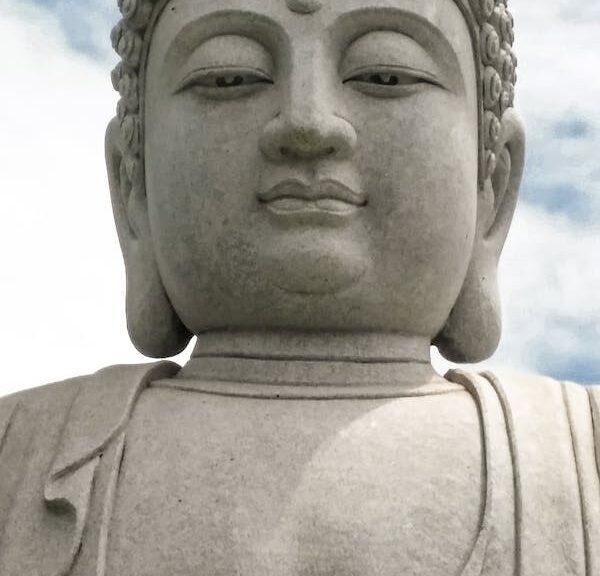
ZEN BUDDHISM
Zen chan awakening satori represents one of the most direct paths to inner realization ever transmitted in human history. From Bodhidharma’s radical reform to the paradoxical Koan, from Za Zen to Satori, this living tradition cuts through rites, scriptures and mental speculation to point at a single reality: the Cosmic Mind present in the heart of every human being. This article traces that path, its history, its teaching, its practice, and the state of Awakening it aims at.
Zen Chan Awakening Satori: A History of Reform and Transmission
The spiritual impulses regularly launched by envoys are subject to the law of this world: the law of change, crystallization and degeneration. From the beginning, Buddhism presented itself under two aspects: the Dharma, which is the intangible, eternal law, and the Sasana, which is the teaching manifested in the world of « rising, shining, descending », subject to space-time and therefore destined to disappear once its task is accomplished.
Unfortunately, humanity regularly clings to the empty form left after the passage of an envoy. Inner realization is projected outside and we witness the creation of an exoteric religion.
Thus Hinduism had lost itself in the worship of a multitude of Gods, forgetting the essential, Bhraman, the Unique Spirit source of all things. It took several centuries to see the first outward manifestation of Buddhism: the statues of Buddha appeared only around the 1st century AD.
The Buddha’s teaching was oral. He taught his disciples that each one must find within themselves the path to enlightenment by following the Noble Eightfold Path. His words were noted down, commentaries were added, great saints gave their vision of the teaching. All these sacred texts were written and copied by monks who devoted their lives to this task, resulting in a treasure of tens of thousands of books.
But writing, reading and meditating on these texts cut the seekers of truth off from reality, preventing them from practicing the Path of Enlightenment. To combat one illusion, they had created another, even more formidable because more subtle.
The teaching therefore had to be reformed once again, or rather revived. This was essentially the mission of Bodhidharma who, coming from India in the 6th century, propagated Mahayana Buddhism, called the Great Vehicle, in China. His teaching took the name of Ch’an, then became Zen when it passed to Japan. To break with the deviations committed, he advocated the practice of meditation in direct contact with the Cosmic Mind, the Supreme Reality present in the heart of each being. He swept aside the abundant sacred literature which, according to him, had no use in progressing on the path of zen chan awakening satori. As Hui-neng (638-713) said:
« Do not let yourself be upset by the Sutra, rather upset the Sutra yourself. »
In Bodhidharma’s eyes, Buddhism had to be a living religion, free from rites, magic, scriptures and intellectual speculations. One thing mattered above all else: the actual achievement of the state of awakening.
The spirit and goal of zen chan awakening satori were according to him: an oral transmission outside of the scriptures, no dependence on words and letters, a direct search for the essence of man, seeing into one’s own nature and attaining perfect awakening.
Bodhidharma was not the only initiator of Ch’an Buddhism, which in fact succeeded the Chinese Mystical School. The latter aspired to achieve the synthesis of oppositions existing between Spirit and Matter, between the Supreme Essence of the Universe and external appearances. The main initiators were Tao-an (312-385), then Tao-cheng (360-434) and Seng-chao (384-414), student of the Hindu monk Kumarajiva, translator of the Sutras into Chinese.
Ch’an Buddhism entered Japan from the 6th century through Korea. One of the main figures responsible for its spread in Japan was Myoan Eisai (1141-1215), who went to China and on his return created the Rinzai school, founding the Shofukuji temple in Katata in 1194, which still exists today.
Another great initiator of Zen was Dogen Kigen (1200-1253) who, also returning from China, created the Soto Zen school, attaching more importance to the meticulousness of daily practice than to the mental search for inner illumination.
Also notable is Hakuin (1685-1768) of the Rinzai school, initiator of the Koan method: paradoxical statements that cannot be understood by the intellect, forcing thought into silence and allowing the manifestation of a higher level of consciousness.
Finally Bankei (1622-1693) insisted on the importance of perfect attention to all details of daily life and opposed training in meditations that could establish a split between spiritual life and ordinary life.
Zen has also degenerated into sects such as Amidism, founded by Honen (1133-1212), based on the vow of the Bodhisattva Amitabha, similar in structure to Catholicism’s promise of salvation through belief. The inner path is transposed into an external intervention. However, the great Buddhist masters have always declared that no awakened person can do anything for the disciple. Each must find Awakening in themselves, through practice.
The Teaching of Zen Chan Awakening Satori: Buddha Nature and the Illusion of Self
Buddhism teaches us that the Nature of Buddha, the Divine Nature, is present, like the mystical rose, in the heart of every human being.
As Hsi-yun (-850) said: « The Cosmic Mind is the Buddha… and the Buddha is all living beings. This Mind is no less manifested in ordinary beings, nor more manifested in the Buddha. »
We are the supreme reality, we are the Cosmic Mind, but we do not know it. We therefore have nothing to accumulate, but rather to release the treasure that lies in the depths of consciousness: to undo the innumerable complications that imprison us, karmic, astrological, hereditary influences.
The religious man tries to discover the secret link that unites him to the divine presence that dwells in himself and in all things. There is no distinction between creator and creatures, no communion but an integration.
The main obstacle to this work is our Self, our consciousness which is in fact only an illusion, an uninterrupted flow of disjointed thoughts. Dogen, in the Soto Zen school, taught that the Spirit must be freed from all attachment: family, education, reading.
The study of the inertia of the force of habit is one of the main concerns of zen chan awakening satori. The force of habit engenders inner poverty, laziness, monotony, unconsciousness and ignorance, and is directly opposed to Awakening. As it is said in the Diamond Sutra:
« We do not perceive the world as it really is. Our imagination, nourished by the energy generated by habit, superimposes on the world an illusory construction, a mirage, images similar to those seen in dreams. »
Zen Chan Awakening Satori in Practice: Wu Wei and Za Zen
Zen chan awakening satori offers a freedom from this dream. This liberation requires work done in depth, not simply becoming aware of bad habits and practicing opposing ones, but going very deep to put an end to the very process of habit in its entirety. To do this, the disciple must strive to calm the flow of thoughts until seeing the interstitial void between two thoughts, and concentrate on that void.
The Void comes from the Sanskrit Sunyata, meaning Non-Self, not a nothingness, but the absence of our usual values, our dualistic conceptions, the attributes we grant to beings and things. It is Non-Attachment.
Master Eckhart expressed it thus: « To be empty of all creation means to be full of God, and to be filled with creation means to be empty of God. The empty heart has power over all things. »
Another concept from Taoism, often misunderstood, is Wu Wei or Non-action, not inaction, but action based not on the ego but on the other reality in us. It expresses the need for silence among the agitations of the Self.
As Lao Tzu said: « Although the Tao has no goal, it leaves nothing unfinished. » And: « I practice Non-action and the people transform themselves. I do not act for profit and the people enrich themselves. I am without desire and the people return to primitive simplicity. »
We must concentrate on what we are doing, live in the present and not let thoughts of the past and speculations about the future invade us.
« When you sit, sit; when you walk, just walk. But above all avoid mental agitations. » Yun-men (-945)
« Do not think of good, do not think of evil, but look at what is, at the present moment, your original physiognomy: the one you had even before being born. » Hui-neng (638-713)
« If you cannot find the reality where you are, where do you hope to find it? » Nyogen Senzaki
« What a supernatural wonder! And what a miracle. Here: I draw water and I carry wood. » P’ang-iun
The process is individual and must be lived inwardly by each one. « Be your own lamp. » The Buddha.
Buddhist monks are not intermediaries between God and men. They show the road that each one must travel by their own efforts, their own lucidity. Their role is limited to denouncing the obstacles that prevent awakening to our real nature. Of the latter, nothing can be said. « I know that I know nothing. » Socrates.
Za Zen, sitting meditation, should not be taken literally. This meditation must be practiced continuously, whatever one’s activity. It is a permanent orientation on the goal to be achieved: Awakening. There is no separation between meditation and action.
« When you train in Za Zen, you should know that Ch’an is neither sitting nor lying down. If you transform yourself into a seated Buddha, by that very fact you kill the Buddha. » Huai-jang
Karma, the law of cause and effect, is central to this understanding. To each cause for which we are responsible corresponds an effect that must manifest itself. No external power, no master, no God can interfere in this process.
« By oneself alone, evil is done. By oneself, evil is undone. By oneself alone, one is purified. No one can purify another. » Dhammapada
Satori: The Heart of Zen Chan Awakening
The goal of zen chan awakening satori is to enter Nirvana. The Masters of Ch’an and Zen use the expression « to return home », return to the Father, to the Original Kingdom. Satori is achieved by the cessation of all self-affirmation. One must die to oneself. Personal consciousness dissolves and integrates with the universal consciousness of the Cosmic Mind.
Nirvana comes from Nirva, meaning to go out: extinction of the flame of the Self, of its attachments, its desires, its ignorance. The result is not nothingness but a plenitude that does not result from any rational work.
Awakening or Satori is not a result built by mental manipulations. The inner attitude preparing for Satori consists of clearing away habits and useless attachments. As D.T. Suzuki wrote: « The whole discipline of Zen can be considered as consisting of a series of efforts to free ourselves from all forms of servitude. »
Satori is characterized by an intuitive vision going beyond mental representations, supra-rational, beyond the familiar dualities of spectator and spectacle. In the experience of Satori, the Cosmic Mind reveals itself in its unity and total homogeneity. As Fa-tsang (643-712) expressed it: « As soon as enlightenment comes, the distinctions between the illusory and the true disappear. »
Koan, Haiku and the Arts of Zen Chan Awakening Satori
The Koan is a Zen problem, a question whose answer is totally irrational. Examples:
« What is the Buddha? 3 pounds of flax! » T’ung-shan « What was your face before you were born? » Hui-neng « What is the sound of a single hand? » Hakuin
The student is thus finally led to feel completely unknowing. The mind seeking to know the mind, the Self seeking to control the Self, are annihilated. The opaque veil of personality masking the Reality behind appearance dissolves.
Haiku are small poems of 17 syllables that appeared in the 17th century in the spirit of Wu-shih, « Nothing special. » They translate things in their naturalness, without commenting on them:
« The long night; the sound of the water says what I think. » « With the evening breeze, the water licks the heron’s legs. » « Melted snow falling; unfathomable, infinite solitude. »
The constant theme of all Zen arts is the aimless life, the expression of the artist’s state of mind. The favorite subjects are natural, concrete, everyday. Artists inspired by zen chan awakening satori touch the soul by using emptiness: blank space in painting, silence in music, the ellipse in poetry, immobility in dance. Each work emphasizes the other Reality, provoking a questioning in the one who contemplates it and cannot grasp it with the Ego.
Japanese Martial Arts express the virtue of Non-struggle, not resisting the force of attack but welcoming it, as the reed bends under the snow and wind. As Lao Tzu said: « There is nothing in the world more inconsistent and weaker than water; however, it corrodes what is hard, nothing can resist it. »
Archery represents the Original Trinity, Essence, Potentiality, Manifestation, and the 3 Jewels of Buddhism: the Buddha (the shooter), the Dharma (the arrow), the Sangha (the target). When shooter, arrow and target become one, the arrow leaves by itself and strikes the center of the target, its heart.
In conclusion, zen chan awakening satori is not a method but a state of mind governed by spontaneity, an acceptance of human nature that recognizes its limits, thereby allowing detachment from it, and giving the Supreme Reality present in us the possibility to manifest itself once again.
Sources: Zen, Robert Linssen, Marabout University / Zen Buddhism, Alan W. Watts, Payot / Essay on Zen Buddhism, D.T. Suzuki, Albin Michel
For further reading on Zen Buddhism and the path to awakening: Zen, Wikipedia